
Moran took control of the North Siders and immediately tried to elevate the body count. Top enforcers Frank Gusenberg and his brother Peter “Goosy” Gusenberg, however, failed in their attempt to wipe out Capone’s associate “Machine Gun” Jack McGurn.
Moran, realizing the power of the Unione Siciliana, forged an alliance with Chicago bootlegger Giuseppe ‘Joe” Aiello, who had also sought control of the group. But Capone, as always, had other ideas. Aiello brothers Salvatore and Frank were shot down on Nov. 10, 1926 atthe Aiello brothers bakery, whichwas riddled with bullets. Frankie Yale, who had joined with Joe Aiello after his falling out with Capone, was gunned down in his car in New York on July 1, 1928. (The gunmen were said to be Fred “Killer” Burke, Gus Winkeler, Fred Goetz and Louis “Little New York” Campagna-former members ofthe disbanded St. Louis Egan’s Rats gang. Capone called this new group of men “The American Boys.”) To further dissuade Joe Aiello, Capone had his uncle Dominick killed weeks later.
The North Sider Gusenberg brothers redeemed themselves for failing to kill McGurn by taking down Capone’s newly selected Unione Siciliana president, Antonio “The Scourge” Lombardo.
Then on Jan. 8, 1929, Joe Aiello and Moran paid a visit to the home of Lombardo’s replacement, Pasqualino “Patsy” Lolordo. Shots rang out, and the president’s seat was vacant once again.
By now, the crime wave had shaken not just the city’s residents to the core, but the very mobsters in the midst ofit as well.Yet Moran knew he had to keep the pressure on Capone in order to stanch the bloodshed. He called a meeting for the morning of Feb. 14, 1929 at the brick SMC Cartage Company garage. “The SMC Cartage garage was not Moran’s headquarters,” says Rose Keefe, author of The Man Who Got Away: The Bugs Moran Story. “They stored their trucks at the garage, but it had only recently been called into use as a meeting spot because Moran suspected a traitor in the ranks and needed to meet his trusted men in a spot where they’d be least likely to be observed.” The meeting was scheduled for 10:30,but Moran was runninglate. Says Keefe: “Moran stopped in the Parkway hotel barbershop for a haircut that ran overtime, putting him 10 minutes behind schedule.”
According to some accounts, also running late were Ted Newberry, Henry Gusenberg (Frank and Peter’s brother), and Willie Marks. Once they got close to the garage, they noticed a police car out front. Believing a raid was imminent, they scrammed. In the next moments, one of America’s most brutal crimes unfolded.
Inside the garage were five of Moran’s men. Also present were Reinhardt Schwimmer, an optician who enjoyed the prestige of associating with the notorious North Siders, and John May, who worked as a car mechanic for Moran. A Cadillac sedan pulled up in front of the garage. Four men got out, two dressed in police uniforms, and entered the garage. A few minutes later popping sounds were heard. Witnesses saw thetwo “police officers,”with guns drawn, lead out two men with their hands raised in the air. They all climbed into the Cadillac and it tore off. A second car, a Peerless,was seen behindthe garage; ittoo sped away. It appears the two “officers” lined up Moran’s men against the garage’s brick
THE MOB WARS IN PROHIBITION-ERA CHICAGO CAME TO A GRISLY HEAD WHEN SEVEN MEN WERE GUNNED DOWN DURING GANGLAND’S MOST NOTORIOUS SLAYING.
BY MARCY KENNEDY KNIGHT
D flowers-that was a given. As part owner of Schofield’s flower shoр, he kept a ready supply of carnations, roses, chrysanthemums, orchids and lilies-the flowers most often displayed for funerals. In Chicago in the early ’20s, there was no shortage of funerals, typically costing thousands. O’Banion’s “other” business-running gambling houses and managing Chicago’s distribution of illegal booze-kept the funeral business in business. His flowers even adorned the funerals of those whose deaths he had caused. In his back pocket O’Banion kept a pair of shears he used to perfect floral arrangements. Also in his “back pocket” were some of the city’s elite: politicians, attorneys, judges, city officials and high-ranking law-enforcement officers. His “other” gigs were extremely profitable, and with the right palms greased, O’Banion did well.
Today Prior to the start of Prohibition on Jan. 17, 1920, O’Banion was a labor slugger with a minor criminal background that included theft and an arrestfor carrying a concealed weapon. But the enactment of the new law created opportunities for men like him, says Chicago mafia expert Mario Gomes. “Prohibition made many aspiring criminals into respectable gangsters,” he says. Gomes estimates that in Chicago during the first year of Prohibition, 10,000 speakeasies were operating. Prohibition, quite simply, made O’Ban-ion and other gangsters powerful and rich. Three gangs dominated Chicago’s 1920s underworld: the North Side Gang (primarily Irish), led by O’Banion and “Hymie” Weiss; the South Side Gang (Italians), led by Johnny Torrio and his number two, Al “Scarface” Capone; and the Genna Brothers (“The Terrible Gennas”), who ran the section of the city known as Little Sicily. The “business” endeavors of these gangs included bootlegging, racketeering, prostitution, extortion, kidnapping, murder for hire, union busting and “political” assistance.
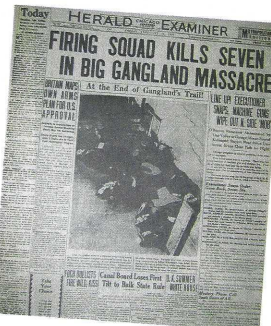
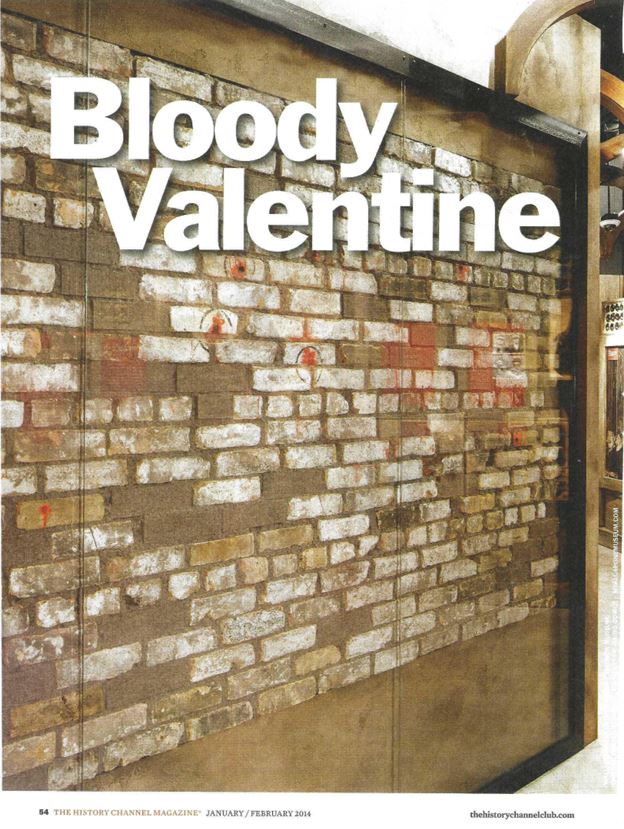
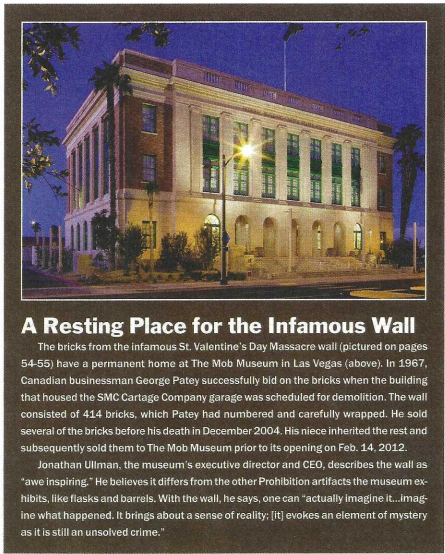
The brick wall from the SMC Cartage Company garage where seven men were shot with a barrage of gunfire in 1929 now has a home among other gangland artifacts (see sidebar). A front-page news story from the Herald Examiner (inset) gives the gory details.
On the morning of Nov. 10, 1924,
Schofield’s flower shop was busy; two days earlier, Mike Merlo, president ofthe Unione Siciliana-which provided insurance to Sicilian immigrants to Chicagohad died of cancer. Since its founding in 1893, Unione Siciliana had evolved into a powerful union, one the mob wanted to control. In 1914, Sicilian mobster Ignazio “the Wolf” Lupo became the group’s president, and it remained under mob control for decades. During his tenure, Merlo had been instrumental in maintaining a semblance of peace among the city’s top gangs. But now that he was gone all bets were off. That morning of the 10th, a handful of men entered Schofield’s to “order flowers” for Merlo’s funeral. One pulled outa .38 and murdered O’Banion, shooting him severaltimes. The crime has never been solved, but the shooters were believed to be Frankie Yale (a New York gangster and associate of Torrio’s and Capone’s) and contract killers John Scalise and Albert Anselmi, known as the “killer twins.” O’Banion’s murder ignited “The Beer Wars,” otherwise known as the “Battle of Chicago.” For the North Siders, blood revenge was the only satisfactory response. Two months later, the gang riddled Capone’s car with gunfire, but he survived. Shortly thereafter, Torrio survived a murder attempt led by Weiss, George “Bugs” Moran and Vincent “The Schemer” Drucci. With Torrio in jail (on an arrest related to a raid at the Sieben Brewery, owned by O’Banion and then Torrio), Capone assumed control ofthe South Siders. One of his goals was to insert his handpicked man as the Unione Siciliana leader. The group’s president “Bloody” Angelo Genna was killed on May 26, 1925. Weeks later, Genna’s brother Mike was dead too. (The next president, Sam “Samoots” Amatuna, leading member of the Genna gang, was gunned down on Nov. 13. Drucci was the presumed shooter.) In September the North Siders, intent on eliminating Capone, shot up an Italian restaurant where the mobster was having lunch; again he survived. Less than a month later, Weiss was gunned down outside Schofield’s.
As the North Siders were accustomed to “shakedowns” by the police, they surrendered their weapons and lined up as instructed, with their backs to the “police.” The other passengers from the Cadillac pulled out Thompson submachine guns and sprayed the men with a hail of bullets.
A nearby tenant entered the garage after the “police” left. Once inside he reportedly discovered six dead men. Frank Gusenberg, barely alive, had dragged himself away from the carnage. He died in the hospital a few hours later, refusing to reveal who had shot him.
According to autopsy reports the victims were:
John May: about 10 entrance/exit wounds.
Adam Heyer: about 15 entrance/exit wounds.
Albert Kachellek, aka James Clark: about nine wounds. Albert Weinshank: about nine wounds. Peter Gusenberg: about 11 entrance/exit wounds.
Frank Gusenberg: about nine wounds although only seven bullets were recovered.
Reinhardt Schwimmer: 25 entrance/ exit wounds. Sixteen were lead pellets in the back from a shotgun blast.
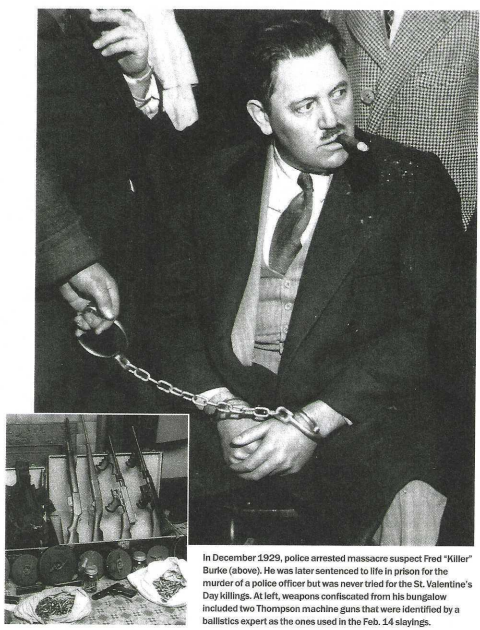
As the days turned into weeks, then months, the case started to grow cold. Witnesses changed their stories, disappeared or were found dead. The main suspect, Capone himself, conveniently happened to be in Florida the day of the killings, meeting with a district attorhey. Capone’s top gunmen were ed then released due to lack of evidence. A potential break in the case came on Dec. 14, 1929, when police in Michigan raided the bungalow of suspect Fred “Killer” Burke after his deadly confrontation with police officer Charles Skelly. Among the array ofweapons confiscated were two Thompson machine guns. Ballistics expert Calvin Goddard identified the Thompsons as the ones used in both the murder of Frankie Yale and in the St. Valentine’s Day Massacre. Author and public safety professional Chriss Lyon explained, “If it wasn’t for [Skelly] being shot and killed Deс. 14, 1929 by Fred ‘Killer’ Burke, the science of forensics and ballistics would not have become part of the mainstream, at least not for a while longer.” Burke was sentenced to life in prison (and served nine years) for Skelly’s murder; he wa never tried, however, for the Feb. 14 killings.
On Jan. 8, 1935 the FBI captured members of the Barker Gang, including Byron Bolton. He claimed to be one of the lookouts during the massacre, and he named the triggermen. Georgette Winkeler, widow of Gus Winkeler, one of the killers, corroborated Bolton’s story.
Still, as of today, the crime remains classified as “unsolved.” Bugs Moran died of lung cancer in Leavenworth Federal Penitentiary in 1957 at the age of 65. But it was the St. Valentine’s Day Massacre, in 1929, that truly ended the dominance the North Side Gang once enjoyed.
It also marked the beginning of the end of Capone’s reign. The mob syndicate was tired of his high-exposure incidents, and the government coded him as Public Enemy No. 1 to be brought down at all costs. In 1931, Capone was convicted of tax evasion and sentenced to 11 years in prison. He died of a heart attack at his home on Jan. 25, 1947. Hе was 48.
What of the funerals of the seven men killed on Feb. 14, 1929? Capone sent flowers; that was a given. Capone also knew his flowers.
MARCY KENNEDY KNIGHT is an award winningwriter living in South Florida.