

Before the big-eyed and big- lipped Bratz dolls, before the chubby-cheeked Cabbage Patch Kids,even hefore the curvaceous Barbie, there was Kewpie.
Kewpie dolls exploded onto the American scene in 1912-the same year New Mexico and Arizona became states, the SS Titanic sank on its maiden voyage, and New York passed the 54-hour work week law.
Kewpie was the creation of Rose O’Neill, then America’s highest paid female illustrator. She created Kewpie in 1909 while recovering from two failed marriages. There are several storiesbehind the creation of Kewpie. Rose told the Woman’s Home Companion that little elvin creatures appeared to her in a dream. “They were all over my room, on my bed, and one perched on my hand. I awoke seeing them everywhere.” But shetold Hobbies magazine, “The idea grewfrom a baby brother when I was a little girl. I made drawings of himwhile I played with him. Allhis little looks and gestures came out later in the Kewpie”
She said she invented the Kewpie name “for little Cupid, spelling it with a к’ because it seemed funnier.”
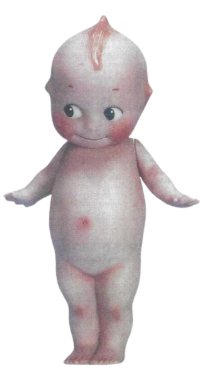
However the idea came to her, Kewpies were an instant hit. The smiling dolls had plump nude bodies,and chubby little thighs like that of a child. They had a small topknot and puffs of hair on either side of their heads. Their large, friendly eyes were in a side-glancing pоsitionwhile their childlike hands were in the shapes of starfish. Some had tiny blue wings.
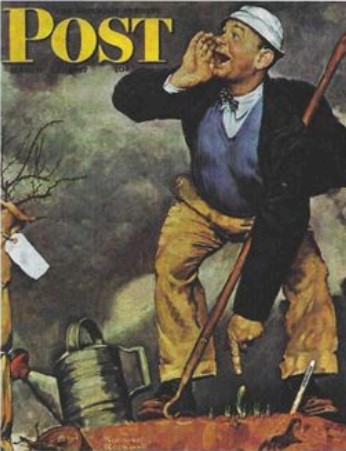
Rose’s Kewpie illustrations first appeared in the 1909 Christmas issue of Ladies Home Journal, and the demand for more of them was instant.
“Kewpie Kutouts,” paper dolls (the first time a pаper doll had a front and back), appeared regularly in magazines and newspapers across the country, and merchandizing BY MARCY KENNEDY KNIGHT for the dolls exploded. Kewpie images were put on such things as doorknockers, cups, plates, coloring books, poetry books, lamps, postcards, and jewelry. The item thatwas most treasured, most wanted, and most sought after was the Kewpie doll.
In 1912 Geo. Borgfeldt & Co. of New York contractedwith O’Neill to develop a line of Kewpie dolls and figurines.The mold was created by a 17-year-old art student, Joseph Kallus. The dolls and figurines would be produced in Germany-then the world center ofdoll and toy manufacturing and a place where Borgfeldt had contacts. Additionally, the production of porcelain was more economical there than in the United States.
The first Kewpies were produced by the German firm Kestner & Company in the small city ofOhrdruf. The dolls bad “O’Neill” inscribed on a foot and a red heart on itschest. Once they hitAmer ica, demand exploded. The dolls were produced in nine different sizes, and 21 factories in Germany were making Kewpies to meet the overwhelming demand. O’Neill traveled to and from Germanyto oversee the creation of her dolls, and she demanded that the smaller dolls have as much detail as the larger ones.
O’Neill returned to the United States following the assassination of Archduke Franz Ferdinand of Austria on June 28, 1914, the eventwhich ignited World War I. During the war the porcelain and bisque Kewpie dolls were manufactured in Belgium and France,while wood and celluloid dolls were made in the United States.
According to 200 Years of Dolls (fourth edition), a 10-inch Kewpie with a bisque head, composition body, and glass eyes today is worth $6,500; a 20- inch doll is valued at $20,000.
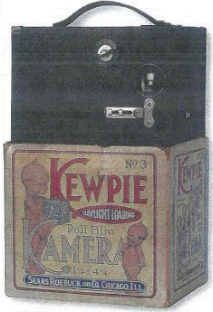
As Kewpie dolls and figurines filled he arms of little girls throughout the vorld, Kewpie continued to find its way nto American homes. In 1915 Kewpie eamed up with Jell-O for the Jell-0 Recipe Book. Kewpies were dancing all ver Kellogg’s Corn Flakes boxes, and hey encouraged women to buy Lifebuoy soap and Oxydol laundry Hetergent. There was Colgate Talcpowder with Kewpies. And Kewpie Kameras, sold exclusively by Sears, Roebuck and Company. Hungry? There were also Kewpee Hamburgers. Since 914 Kewpie has been the official mascot of David H. Hiekman High School in Columbia, Mo., Principal Dr. Tracey Conrad explained, “It takes a certain evel of toughness as a football player to have Kewpie as your mascot.”
In the mid-1920s Kewpies started to get elothing. They were dressed as American and European soldiers, bellhops, firemen, cowboys, and sailors. Cloth dolls were created with bisque heads, and one famous manufacturer was Margarete Steiff, the founder of Steiff Bears.
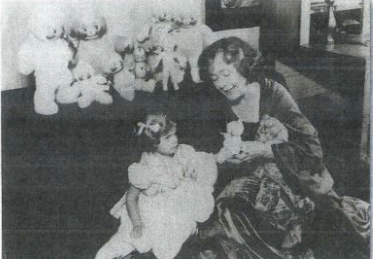
Rose O’Neill offersa seloection of Kewple doils to a youngchlid duringthe late 1930s. Only a fewyears later the Kewpie craze would come to an end, leaving O’Nelll impoverished.
In the early 1930s Richard G. Kruger manufactured soft dolls to meet the continuing demand. Effanbee, Cameo, Jesco, King, Milton-Bradley, and Strombecker all have created Kewpies at different times in history.
Kewpies also achieved a level of prestige not seen by other dolls. Many well-known people, including Holocaust diarist Anne Frank, owned muchloved Kewpie dolls. John Steinbeckk included a kewpie in Of Mice and Men. And perhaps its greatest honor came when a Kewpie was included in 1939 New York World’s Fair time capsule. The doll was nestled along with such items as LIFE magazine, writings by Albert Einstein, and a pack of Camel cigarettes.
By the early 1940s the Kewpie craze had come to an end. Photographs were nowbeing used in advertisements; illustrations were passé. Little girls played with their Shirley Temple and Raggedy Ann dolls. O’Neill had a difficult time finding work; she died impoverished in April 1944.
The Kewpie doll was immortalized in 1968 when an amusement park attendant gave Max and “99” a plutoniumfilled Kewpie in TV’s Get Smart. The U.S. Postal Service recognized Kewpie with a stamp in 2001. And every April, Branson, Mo., holds its annual Kewpiesta Festival.
Today, Kewpies are stillpopular with people of all ages as well as collectors, and Charisma Brands continues to produce the Cameo Kewpies. In February 2006 the “Strawberry Kewpie Licious” was nominated for a Dolls Award of Excellence by Dolls magazine. And in January 2007 “Gone Fishing Kewpie” was also nominated. The Kewpie doll was ranked at No.12 in a Dolls readerpoll askingfor the top 100 dolls of all time.
Rose O’Neill believed, “The world needs to laugh, or at least to smile more than it does.” Through Kewpie-a doll created nearly 100 years ago-she was able to achieve this.
MARCY KENNEDY KNIGHT is a freelance writerfrom Margate, Fla.