
Where History Bloomed: The Story of the White House Rose Garden
The White House Rose Garden once stood as one of the most recognizable and symbolically rich outdoor spaces in the United States. Situated just outside the West Wing, it functioned as both a place of cultivated beauty and a stage for some of the nation’s most consequential public moments. Over more than a century, it evolved alongside the presidency itself—shaped by shifting tastes, political needs, and the personal visions of those who occupied the White House.
Early Origins: Before the Roses
Before it became known for its carefully arranged blooms, the area was far more modest. In the early 1900s, during the presidency of Theodore Roosevelt, First Lady Edith Roosevelt oversaw the creation of a colonial-style garden in the space. Her design favored informal plantings—wildflowers, daisies, and jasmine—reflecting a softer, more naturalistic approach inspired by early American gardens.
This early garden coincided with major changes to the White House grounds, including the construction of the West Wing. Its proximity to the president’s working offices would later prove significant, turning what began as a decorative landscape into a functional extension of executive life.
The Emergence of the Rose Garden
The transformation into a formal Rose Garden began in 1913 under First Lady Ellen Wilson, wife of Woodrow Wilson. With the assistance of landscape architect George Burnap, she reshaped the space into a more structured garden centered on roses.
This decision gave the garden its enduring identity. Roses, long associated with refinement and symbolism, lent the space a sense of dignity that matched its setting beside the seat of executive power. Over time, the garden became not just a collection of plants but a carefully maintained expression of national character.
In the 1930s, during the administration of Franklin D. Roosevelt, the garden was redesigned again by Frederick Law Olmsted Jr. His approach emphasized balance, openness, and year-round visual interest, ensuring that the garden would remain vibrant across seasons.
The Kennedy Era: Defining the Garden’s Identity
The Rose Garden reached its most iconic form during the presidency of John F. Kennedy. Together with First Lady Jacqueline Kennedy, he sought to create a space that reflected both elegance and American identity.
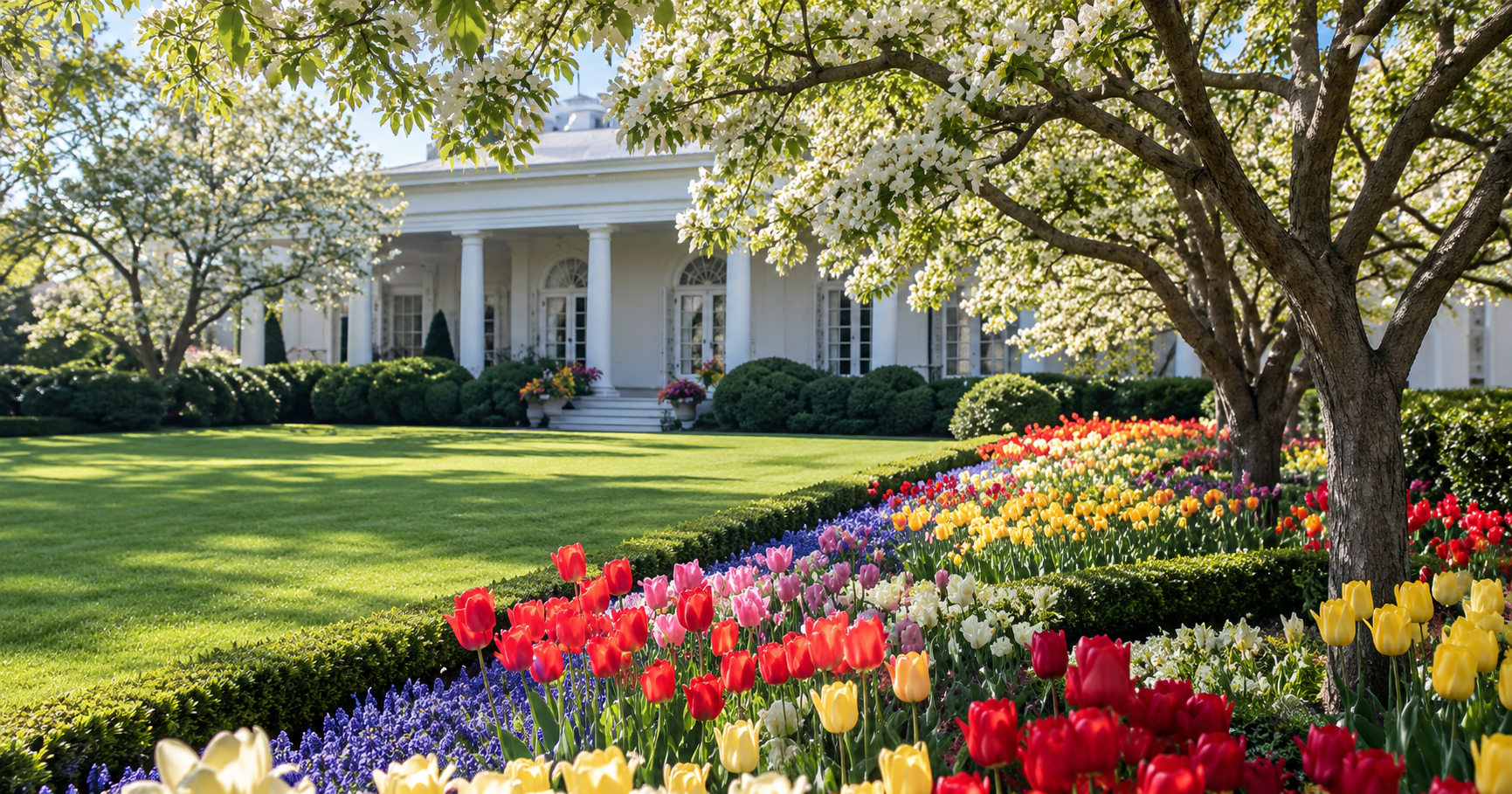
They turned to horticulturist Rachel Lambert Mellon, whose 1962 redesign became the defining blueprint for decades. Mellon introduced a central lawn bordered by symmetrical flower beds, anchored by magnolia trees and framed by the White House colonnade. Her design struck a careful balance between structure and softness, blending formal geometry with seasonal variation.
Under this vision, the garden became more than ornamental. It became functional—a place where the president could step outside and address the nation. It was often referred to as the “outdoor Oval Office,” a reflection of its growing role in public life.
A Carefully Composed Beauty
The Rose Garden’s beauty had always rested in its restraint. It avoided excessive ornamentation, instead relying on proportion, symmetry, and seasonal change. The central lawn provided a clean, open space, while the surrounding beds offered shifting colors throughout the year.
Roses remained the focal point, but they were complemented by a rotating selection of tulips, lilies, and other flowering plants. The magnolia trees added both height and continuity, linking different eras of the garden’s history.
The setting enhanced its visual impact. The white façade of the White House created a striking backdrop, allowing the colors of the garden to stand out vividly. The interplay between architecture and nature gave the space a sense of harmony that few gardens achieved.
A Stage for National Moments
Over time, the Rose Garden became one of the most important ceremonial spaces in the country. Presidents used it to announce major decisions, welcome foreign leaders, and mark significant milestones.
In 1981, Ronald Reagan introduced Sandra Day O’Connor as the first woman nominated to the Supreme Court. In 1993, Bill Clinton announced the nomination of Ruth Bader Ginsburg.
The garden also hosted moments of diplomacy and celebration. It served as the setting for treaty announcements, press briefings, and even personal events, such as the wedding of Tricia Nixon in 1971—the first outdoor wedding held at the White House.
These events reinforced the garden’s dual role. It was both a public space for governance and a private space for the lives of those who lived within the White House.
Changing with Time
Like the presidency itself, the Rose Garden evolved with each administration. Some changes were subtle—adjustments in plant selection or maintenance practices—while others were more visible and sparked public debate.
In 2020, First Lady Melania Trump oversaw a redesign that altered the layout, introduced new plantings, and updated infrastructure. While intended to improve functionality, the changes drew strong reactions, underscoring how deeply Americans cared about the garden’s appearance.
Further alterations followed in subsequent years, shifting the balance between aesthetics and practicality. The garden’s identity, once defined by continuity, became increasingly shaped by immediate needs and differing visions of its purpose.
Meaning Beyond the Garden
The Rose Garden had long symbolized continuity in a place defined by change. Its carefully maintained cycles of growth and renewal mirrored the rhythms of American political life. Administrations came and went, but the garden endured—adapted, replanted, and preserved.
It represented a uniquely American blend of order and natural beauty. Its openness suggested transparency, while its elegance conveyed the dignity of the presidency. Above all, it offered a reminder that even in the center of power, there was space for reflection and quiet.
Conclusion
For more than a century, the White House Rose Garden stood as a living part of American history. It evolved from a modest colonial-style planting into an internationally recognized symbol of presidential tradition. It was a place where decisions were announced, milestones marked, and history quietly unfolded among the blooms.
Its legacy was not only in its design, but in the moments it witnessed and the continuity it represented.
Although its historic design has been significantly altered, the White House Rose Garden remains an important part of the presidential grounds. In 2025, the central grass panel was replaced with a paved patio, while existing rose bushes and ornamental planting beds were retained. The changes marked another chapter in the garden’s long evolution, reflecting the continuing tension between preserving historical tradition and adapting a landmark to modern needs. Though its appearance has changed, the Rose Garden remains a setting for presidential announcements, diplomatic gatherings, and national ceremonies—a reminder that the history of the White House is written not only in its halls, but also in the outdoor spaces where the nation’s story continues to unfold.
References:
https://www.britannica.com/place/White-House-Rose-Garden
National Park Service. (n.d.). The White House and President’s Park: Rose garden history. U.S. Department of the Interior. Retrieved April 22, 2026, from https://www.nps.gov/whho/learn/historyculture/rose-garden.htm
White House Historical Association. (n.d.). The White House Rose Garden. Retrieved April 22, 2026, from https://www.whitehousehistory.org/the-white-house-rose-garden
Seale, W. (2008). The President’s house: A history. White House Historical Association.
Leighton, A. (1987). American gardens of the nineteenth century. University of Massachusetts Press.
Architectural Digest. (2020). The full story behind the White House Rose Garden redesign. Retrieved April 22, 2026, from https://www.architecturaldigest.com/story/the-full-story-behind-the-controversial-rose-garden-redesign
The New York Times. (n.d.). Articles on the White House Rose Garden. Retrieved April 22, 2026, from https://www.nytimes.com
The Washington Post. (n.d.). Coverage of the White House Rose Garden. Retrieved April 22, 2026, from https://www.washingtonpost.com