
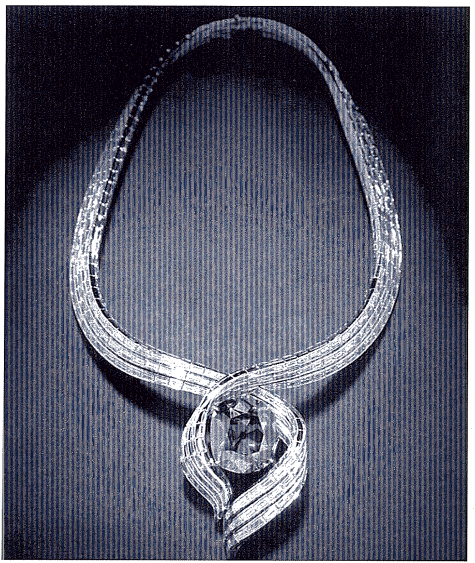
The Hope Diamond. Photo courtesy of Smithsonian Natural History Museum
CARTIER, THE HOPE DIAMOND AND THЕ FLAMBOYANT SOCIALITE
MARCY KNIGHT ENLIGHTENS US ON THE FASCINATING HISTORY OF ONE OF THE WORLD’S MOST BEAUTIFUL PRECIOUS STONES
W wrote, “Legend: A lie that has attained the dignity of age.” That has proven to be true of the infamous Hope Diamond. Horrific stories of its many former owners still circulate today; some stories based on truth, most completely fabricated by its owners, “yellow” journalists, and a talented jewelry salesman playing up the stone’s notorious past.
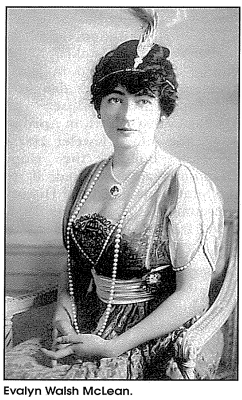
The diamond’s sinister reputation certainly discouraged many buyers of the Gilded Age from considering it, even though it was expected for America’s new millionaires to provide spectacular jewelry to their wives and daughters to flaunt their wealth. There were only a handful of buyers willing to take the chance on the cursed Hope, one being heiress Evalyn Walsh McLean, a woman who claimed objects that were unlucky to others, were lucky to her. Evalyn certainly was no beauty. She had a face that was unforgettable; a sharp nose, bushy eyebrows, and a very thin waist – result of an opium addiction that killed her appetite.
But Evalyn knew how to garner the attention she demanded, and with access to her daddy’s goldmine millions, she was determined to outshine and out-glitter the New York blue bloods who snubbed her, like the Astors, Goelets and Vanderbilts. True, she was dear friends with Alice Roosevelt Longworth and Florence Harding, wife of President Warren G. Harding, but that wasn’t enough. She needed to be noticed. “The yearnings to be seen and heard,” she wrote in her autobiography, Queen of Diamonds, “which I felt in my adolescence were ten times more bedeviling than anything else that gave me irk.”
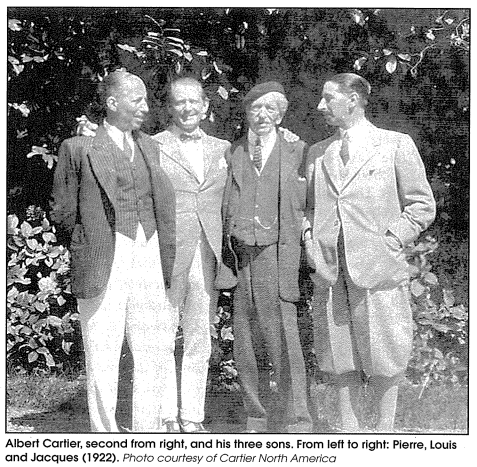
In the fall of 1910, while Evalyn and her husband Edward “Ned” McLean were vacationing in Europe, “fate” came knocking on the door of their Hotel le Bristol suite in Paris. The visitor was the jewelry merchant Pierre Cartier. His polished appearance of a silk hat, oyster-colored spats, and knife-edged trousers were in direct conflict to the married 24-year-old McLeans; Ned was hungover from a night of heavy drinking and Evalyn was foggy from her laudanum usage. Focusing his attention on Evalyn, and knowing she appreciated a good story, he pulled a small package from his coat and held it in his hand, just out of her reach. Some of the stories he told her were how Jean Tavernier, the man who had brought the diamond from India, was torn apart by wild dogs; how King Louis XVI owned it and was beheaded during the French Revolution; Marie Antoinette wore it before she was guillotined; Lord Francis Hope went bankrupt. Story after story followed until she demanded to see the stone. When he unwrapped the jewel, she was unimpressed and sent him away.
After the McLeans returned to Washington in October, Pierre followed behind a month later, determined to sell the Hope Diamond to Evalyn. Pierre left the gem with “Madame McLean” for the weekend. Evalyn wrote, “At some time during the night, I began to want the thing.” On 28 January 1911, Pierre met with Ned and his lawyer, Wilton J. Lambert, where a contract was drawn up for the sale of the Hope Diamond. It read:
“In consideration of the payment of $40,000 in cash, the delivery of an emerald and pearlpendant, and the payment of $114,000 in three annual installments without interest, payable bi-monthly, I hereby agree to sell to Edward B. McLean, what is known as the “Hope Diamond’ and necklace, delivery to be made forthwith, and, if desired by the purchaser, a necklace in the shape of a bowknot and diamonds to be taken at cost and deducted from the sum of s114,000 deferred payment. Should any fatality occur to the family of Edward B. McLean within six months, the said Hope Díamond is agreed to be exchanged for jewelry of equalvalue at the selection of Wilton J. Lambert. It is further agreed that the contract for said deferred payment is not to be negotiated.”
It was signed by Cartier and McLean. Because it was a Saturday night, Ned explained that he would not be able to get the jewelry or the $40,000 cash until Monday; Cartier agreed. Sunday, January 29th, the New York Times ran a full story titled, “JR McLean’s Son Buys Hope Diamond.” The article detailed the purchase of the stone for over $300,000. Pierre wired his father and brother, Louis, that the diamond was sold.
Evalyn’s mother-in-law was horrified when she heard about the purchase, and said, “It is a cursed stone and you must send it back.” Ned also found out that Cartier originally bought the stone two years before for approximately $80,000 – and Cartier was now charging Ned $180,000 for it? And, to top it off, Ned didn’t have the $40,000 he promised Cartier. Evalyn’s father had died a year back, and per the will, Ned and Evalyn only received the interest from the money. Ned’s father, John R. McLean, the owner of the Washington Post and Cincinnati Enquirer, was frugal with his money. He already gave the young McLeans an annual stipend, and refused to pay for the Hope Diamond.
The McLeans decided they wanted nothing more to do with the “hoodoo” stone, but Cartier would not take it back.
After trying repeatedly for months to collect the money and jewelry from the McLeans, the Cartiers filed suit against them in the Supreme Court of the District of Columbia for the full purchase price of the diamond, $180,000. Per the Cartier allegation, “Mr. and Mrs. McLean have possession of the diamond, but they have yet to pay any money for it, nor did they deliver the emerald and pearl pendant as included in the signed contract.”
That’s when the circus began. The McLeans now stated that they were simply “inspecting” the diamond, and they had no intention of ever buying it. They claimed they tried to return the diamond to Cartier who refused to take it back.
The McLeans then said that they had no idea that this diamond had such a sinister reputation; it was never brought to their attention before or during the purchase. They garnered the help of the press with their plight. The New York Times wrote, “Both Ned McLean and his pretty wife are quite young, and in a way unsophisticated… They knew nothing of the history of misfortunes that have beset its various owners.”
On March 25th, both Ned and Evalyn signed affidavits stating that they never received nor accepted the Hope Diamond from Cartier. Evalyn swore that on January 28th, Pierre Cartier did not leave the diamond with her, but took it with him.
The drama continued to play out in the press, with lurid stories of the Hope Diamond’s deadly past. Some of these tales include: Jean Tavernier being ripped apart by wild dogs (not true – he moved to Russia and died there). Marie Antoinette wore it (not true). It was sold to Russian Prince Ivan Kanitovski, who was stabbed to death by revolutionists two days later (he never existed). A friend of the prince, Lorens Ladue, borrowed the diamond and was shot in a theatre box the night she wore it (she didn’t exist). Selim Habib, a former owner, drowned when the boat he was on capsized and the diamond was lost on the bottom of the sea (Selim wasn’t on the boat, and the Hope Diamond was in a safe in Paris).
On 1 February 1912, more than a year after the original “purchase”, and with the court case looming in front of a jury, Evalyn and Ned decided to keep the Hope Diamond. Evalyn finally succumbed to the charm and allure of the blue gem. The next day, she proudly wore her infamous diamond at the most extravagant social event Washington had ever seen, an event she hosted.
Did the curse of the “hoodoo” Hope Diamond continue with Evalyn, a woman who said, “It is no use for anyone to chide me for loving jewels, I cannot help it.” While she owned it, her motherin-law died seven months after she bought it, her husband died in a mental institution, the Washington Post went bankrupt, her young son was killed in a car accident, and Evalyn’s daughter died from a drug overdose.
After Evalyn’s death in April of 1947, the famed jeweler Harry Winston bought the Hope Diamond, and donated it to the Smithsonian Natural History Museum on 10 November 1958, where it sits on exhibit today.
MARCY KENNEDY KNIGHT is an award-winning writer and brand journalist that has written for television, consumer and trade publications, literary journals, blogs, theatre and the web.